Enterprise Data Integration and Marketing Intelligence for International Expansion
Business Context and Data Management Requirements
Interparfums’ proposed international expansion requires coordinated management of sales, inventory, marketing, distribution, and financial information.
The company’s global operating environment presents potential challenges involving data consistency, reporting frequency, currency conversion, and the integration of information from multiple retailers and distribution partners (Inter Parfums, Inc., 2026).
A centralized business intelligence architecture would allow executive leadership to evaluate market performance using standardized information.
The proposed architecture incorporates Extract, Transform, Load (ETL) processes, an enterprise data warehouse, OLAP analysis, and Microsoft Power BI dashboards.
Marketing Data Flow Architecture
The following diagram represents a proposed information flow for the Brazilian market. The architecture is conceptual and does not represent a verified description of Interparfums’ existing information systems.
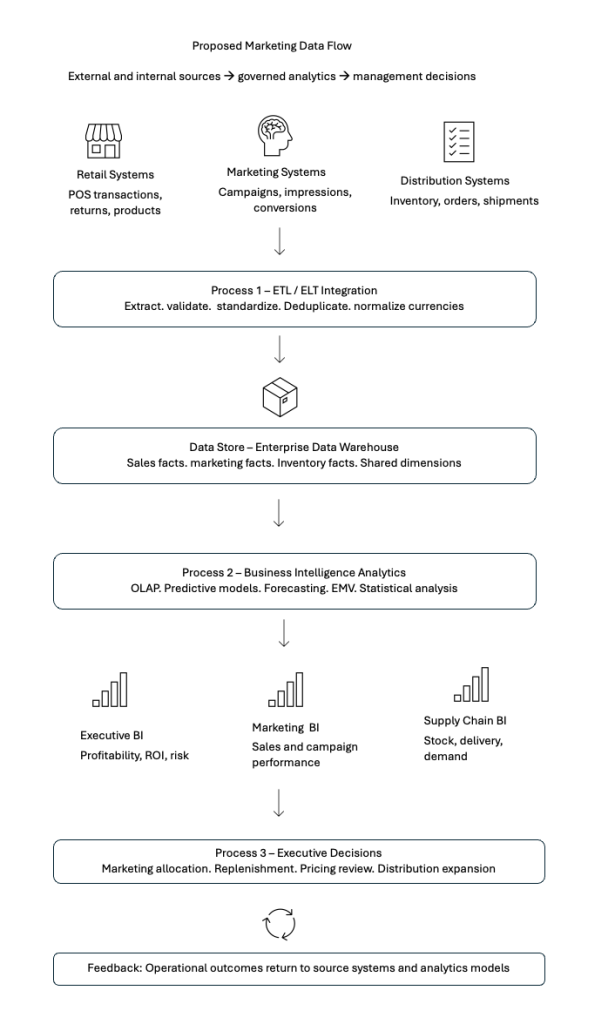
Note. Created by the author in Powerpoint.
Data Collection and ETL Processing
The proposed architecture begins with information generated through retail point-of-sale systems, digital marketing platforms, and distributor records.
ETL processes would validate transaction records, standardize product identifiers, remove duplicate entries, and normalize currency values. These procedures would reduce inconsistencies and improve the reliability of executive reporting.
A governed enterprise data warehouse would organize validated information using fact and dimension tables.
Proposed fact tables include sales transactions, inventory movements, and marketing campaign performance. Dimension tables would contain information related to products, retailers, geographic markets, and reporting periods.
OLAP and Multidimensional Analysis
OLAP provides the capability to analyze business information across multiple dimensions.
Management could evaluate regional sales, identify high-performing fragrance brands, compare retailer productivity, and examine seasonal purchasing patterns.
Drill-down functionality would allow analysis to progress from regional revenue to country, retailer, brand, and product-level performance. Roll-up operations would aggregate detailed information into executive summaries.
Power BI semantic models, relationships, and DAX measures could support standardized reporting across departments (Microsoft, n.d.).
Predictive Modeling and Marketing Performance
Predictive analytics could estimate consumer demand and evaluate the relationship between marketing investments and sales outcomes.
Regression analysis could examine the relationship between promotional expenditure and revenue, while time-series forecasting could estimate seasonal product demand.
Bayesian analysis could revise market performance expectations as new observations become available. Monte Carlo simulation could evaluate potential revenue and profitability outcomes under varying economic and competitive conditions (Montgomery & Runger, 2018).
A proposed executive dashboard would include revenue growth, gross margin, marketing return on investment, inventory turnover, stockout rates, and forecast accuracy.
Data Governance and Information Security
The proposed architecture should incorporate standardized data definitions, role-based access permissions, encryption, data retention policies, and audit procedures.
For Brazilian operations, applicable data privacy obligations should be assessed under Brazil’s General Personal Data Protection Law, commonly referred to as the LGPD.
Data governance should also distinguish shipments to retailers from actual consumer purchases. This distinction would reduce the risk of interpreting distributor inventory accumulation as evidence of increasing consumer demand.
Executive Recommendation
Interparfums should implement a centralized business intelligence environment integrating marketing, sales, inventory, and financial data for the proposed expansion market.
Power BI dashboards should provide executives with consistent performance indicators, while predictive models should support demand forecasting, marketing resource allocation, and operational risk management.
The architecture would strengthen data transparency and support evidence-based decisions throughout the market expansion process.
References
Interparfums, Inc. (2026). Annual report for the fiscal year ended December 31, 2025 (Form 10-K). U.S. Securities and Exchange Commission. https://www.sec.gov/Archives/edgar/data/822663/000175392626000464/ipar-20251231.htm
Microsoft. (n.d.). Power BI documentation. Microsoft Learn. https://learn.microsoft.com/en-us/power-bi/
Montgomery, D. C., & Runger, G. C. (2018). Applied statistics and probability for engineers (7th ed.). Wiley.


Leave a Reply