Six Sigma provides a structured methodology for reducing defects, controlling process variation, and improving operational efficiency. The Define, Measure, Analyze, Improve, and Control (DMAIC) framework is particularly appropriate for evaluating existing processes and identifying measurable improvement opportunities (American Society for Quality [ASQ], n.d.-a).
For Interparfums, Six Sigma could address inventory inaccuracies, supplier delays, production inconsistencies, and fulfillment defects. The methodology would support operational improvement through statistical measurement, root-cause analysis, and continuous monitoring.
Six Sigma DMAIC Process Flow Diagram
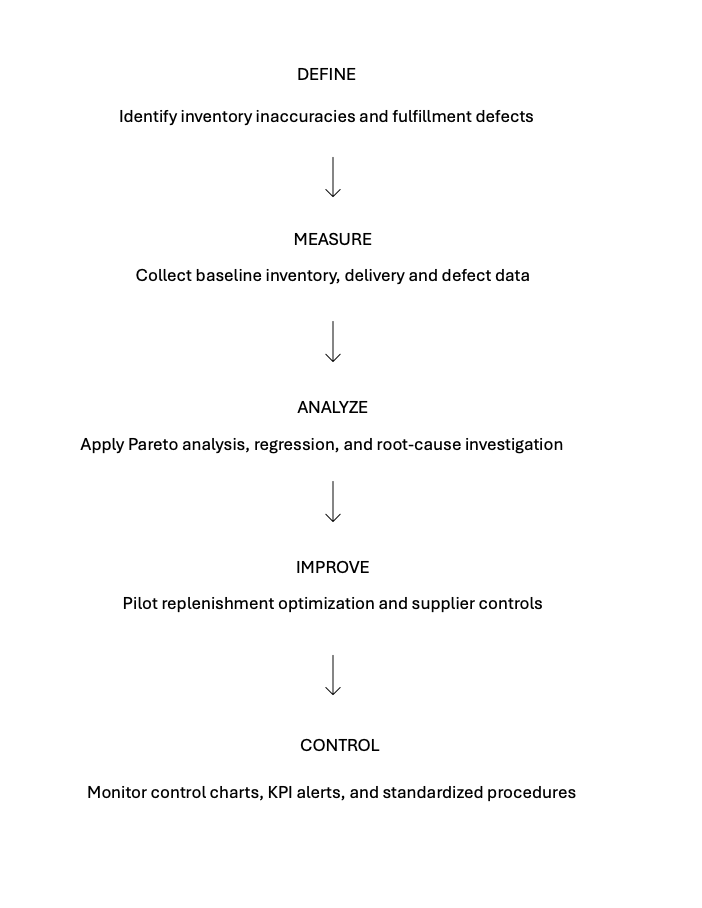
Note. Created by the author in PowerPoint.
Statistical Quality Control and Forecast Monitoring
Statistical process control (SPC) charts could help Interparfums monitor inventory discrepancies, supplier performance, and fulfillment defects. Control charts distinguish common-cause variation from potential special-cause variation, allowing management to investigate unusual process behavior (Montgomery & Runger, 2018).
Illustrative Inventory Discrepancy Control Chart
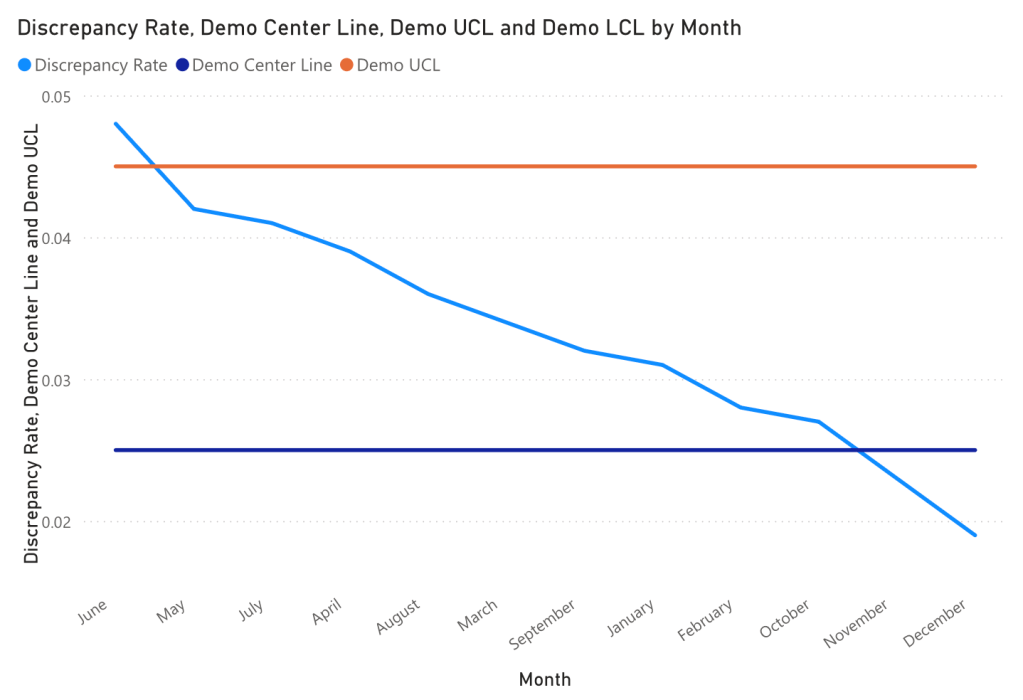
The hypothetical June discrepancy rate of 4.8% exceeds the demonstration threshold of 4.5%, illustrating a potential process exception requiring investigation. Subsequent reductions suggest improvement, although statistically validated control limits and additional observations would be required to establish sustained process stability.
Six Sigma performance could also be measured through defects per million opportunities (DPMO):

For example, reducing hypothetical defective orders from 400 to 150 across 10,000 orders, assuming one defect opportunity per order, would decrease DPMO from 40,000 to 15,000. This represents a 62.5% reduction in defects. Such quantitative measurements align with Six Sigma’s emphasis on reducing variation and improving process performance (ASQ, n.d.-b).
BIA Recommendation: Interparfums should launch a 90-day Six Sigma pilot focused on inventory accuracy and fulfillment quality. The initiative should establish baseline measurements, evaluate root causes, implement corrective actions, and monitor operational performance before expanding successful practices across additional business functions.
References
American Society for Quality. (n.d.-a). DMAIC process: Define, measure, analyze, improve, control.https://asq.org/quality-resources/dmaic
American Society for Quality. (n.d.-b). Six Sigma. https://asq.org/quality-resources/six-sigma
Montgomery, D. C., & Runger, G. C. (2018). Applied statistics and probability for engineers (7th ed.). Wiley.


Leave a Reply