Interparfums, Inc. operates in the global prestige fragrance industry, where profitability depends on consumer demand, inventory availability, supplier reliability, and operational efficiency. The company’s international operations require coordination across sales, production, distribution, and financial reporting systems. In 2025, Interparfums generated approximately $1.49 billion in consolidated net sales and $208.1 million in consolidated net income (Interparfums, Inc., 2026).
Similar to Piaggio’s historical difficulties with declining product quality, ineffective expansion, and operational inefficiencies, Interparfums could experience financial pressure if inventory accumulation and operating expenses increase faster than revenue. Although such deterioration is not established as an existing company-wide condition, the potential misalignment between demand forecasting, inventory replenishment, and production costs represents an important Business Intelligence Analytics (BIA) risk.
Forecasting Methodology and Financial Projections
A hypothetical three-year downside scenario covering 2026–2028 evaluates the potential consequences of unresolved operational inefficiencies. The analysis applies declining revenue growth assumptions and projected net profit margins to illustrate potential financial deterioration. Forecasting techniques, including trend analysis, regression, and sensitivity analysis, can support the evaluation of business uncertainty and future performance (Montgomery & Runger, 2018).
The scenario applies the following calculations:
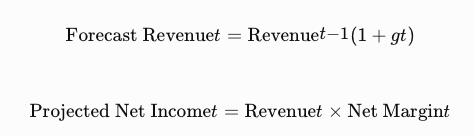
Table 1. Interparfums Hypothetical Financial Forecast
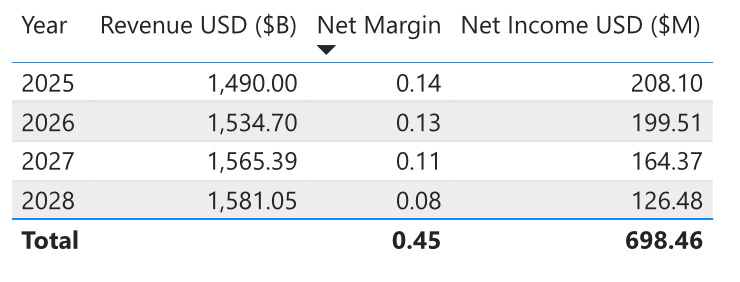
Source: Interparfums, Inc. (2026) for the rounded 2025 baseline; 2026–2028 are hypothetical scenario calculations. Figures are rounded.
Forecasted Net Income Deterioration
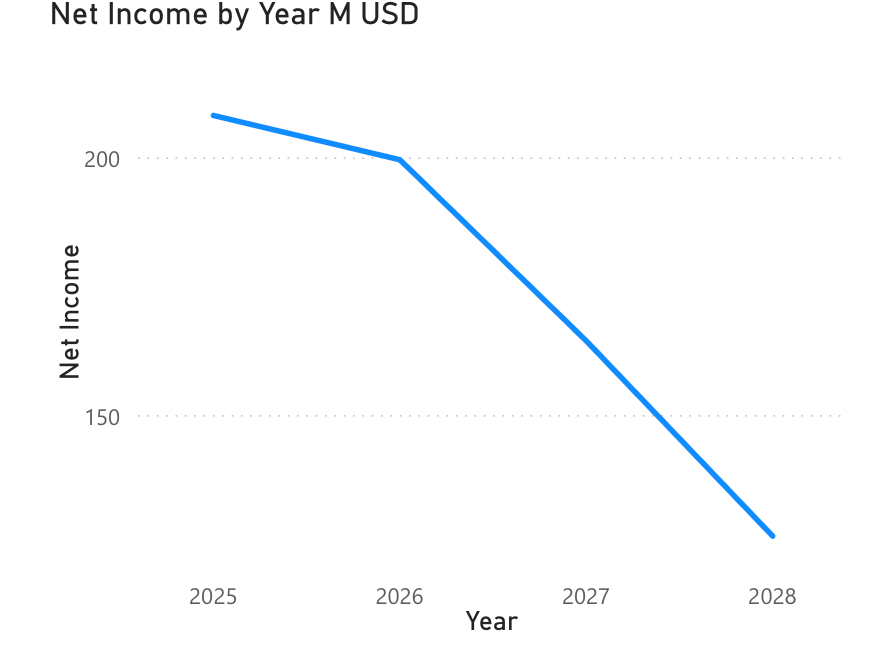
The modeled scenario indicates a potential 39% decline in consolidated net income between 2025 and 2028 despite modest revenue growth. This divergence illustrates how declining profit margins could weaken financial performance even when sales remain relatively stable.
To improve predictive reliability, Interparfums could develop regression models using historical financial observations from 2020–2025. Mean Absolute Percentage Error (MAPE) and Root Mean Squared Error (RMSE) could evaluate out-of-sample forecast accuracy, while sensitivity analysis could examine alternative demand growth and operating margin assumptions (Montgomery & Runger, 2018). The current projections represent scenario assumptions rather than statistically fitted forecasts.
BIA Recommendation: Interparfums should implement rolling 12-month demand forecasting supported by brand-level sales, regional purchasing patterns, inventory turnover, and supplier lead times. Power BI dashboards could compare projected demand against actual sales and inventory availability, allowing management to identify emerging operational inefficiencies before profitability deteriorates.
References
Interparfums, Inc. (2026). Annual report for the fiscal year ended December 31, 2025 (Form 10-K). U.S. Securities and Exchange Commission. https://www.sec.gov/Archives/edgar/data/822663/000175392626000464/ipar-20251231.htm
Montgomery, D. C., & Runger, G. C. (2018). Applied statistics and probability for engineers (7th ed.). Wiley.


Leave a Reply