Applying Joint, Union and Conditional Probability to Promotional Fairness
The proposed Global Fragrance Discovery Sweepstakes includes a Hawaii vacation package awarded to one randomly selected eligible participant. Probability theory provides a framework for examining how the composition of the participant pool influences the likelihood of different outcomes.
For this scenario, assume that all 1,000 sampled consumers qualify for the drawing and receive one valid entry. Each participant would have an equal individual probability of winning.
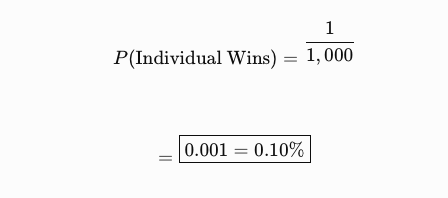
Although individual probabilities are equal, the probability that the winner belongs to a particular customer segment depends on the number of participants in that segment.
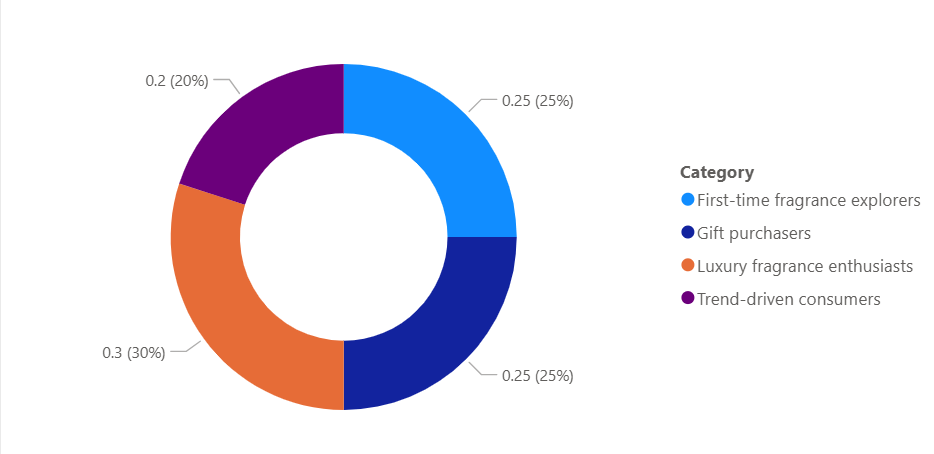
Category Probability Distribution
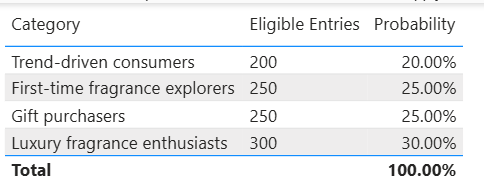
Probability of winning by customer category
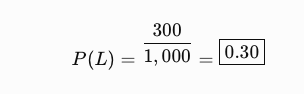
The marginal probability that the winner is a luxury fragrance enthusiast is:
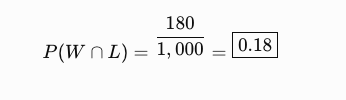
The joint probability that the winner is both a woman and a luxury fragrance enthusiast is:
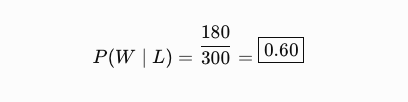
The conditional probability that the winner is a woman, given that the winner belongs to the luxury fragrance enthusiast category, is:
The addition rule can also be used to calculate the probability that the winner is either a man or a gift purchaser:
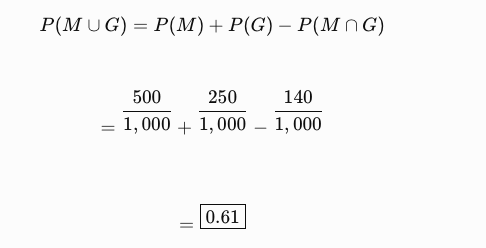
Therefore, there is a 61% probability that the winner is either a man or a gift purchaser, including participants who satisfy both conditions.
Monte Carlo simulation and decision-making under uncertainty
In addition to calculating theoretical probabilities, Interparfums could use Monte Carlo simulation to examine how outcomes vary across repeated random drawings. Simulation is useful when decision-makers want to evaluate uncertainty by generating many possible outcomes based on an established probability model (Montgomery & Runger, 2018).
For example, across 10,000 hypothetical independent drawings with replacement, the expected number of winners from each category would be:
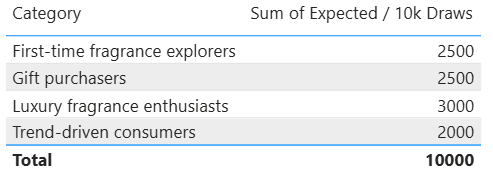
These values represent theoretical expected frequencies, not the results of an executed simulation. An actual Monte Carlo simulation would produce random frequencies that fluctuate around these expectations.
Promotional fairness and risk management
The key distinction is that equal individual probabilities do not require equal group-level probabilities. A category containing 300 eligible participants will naturally have a greater chance of producing the winner than a category containing 200 participants.
To ensure fairness, Interparfums should establish transparent eligibility requirements, use a verifiable random-selection procedure, prevent duplicate or fraudulent entries, and document the drawing process. Purchasing history, sex, and customer segment should not influence winner selection.
The FTC (n.d.) explains that sweepstakes requiring purchases are unlawful in the United States and that state-specific disclosure or registration requirements may apply. These considerations reinforce the importance of legal review and transparent promotional administration.
Business recommendation: Interparfums should implement an auditable random number generator and maintain a Power BI dashboard that tracks eligible entries, category-level probabilities, and promotional participation. These measures would support fair administration while providing leadership with a quantitative understanding of the drawing.
References
Federal Trade Commission. (n.d.). Advertising FAQs: A guide for small business. https://www.ftc.gov/business-guidance/resources/advertising-faqs-guide-small-business
Montgomery, D. C., & Runger, G. C. (2018). Applied statistics and probability for engineers (7th ed.). Wiley.
National Institute of Standards and Technology. (2003). NIST/SEMATECH e-handbook of statistical methods.https://doi.org/10.18434/M32189


Leave a Reply