Customer Segmentation, Promotional Budgeting and Cost-Benefit Analysis
The proposed target customer pool consists of adult consumers interested in prestige fragrances, including established fragrance enthusiasts, gift purchasers, trend-driven consumers, and first-time fragrance explorers. These categories reflect differences in purchasing motivation and provide a foundation for analyzing how consumers may respond to promotional messaging.
Interparfums could reach these consumers through social media advertising, participating retail partners, email marketing to consenting subscribers, and digital promotional campaigns. The company could also evaluate which channels generate the greatest engagement and purchasing activity.
Customer segmentation supports more targeted business decisions by identifying meaningful differences within a broader consumer population. However, the accuracy of these findings depends on the quality and representativeness of the underlying sample. The National Institute of Standards and Technology (NIST, n.d.) explains that random sampling supports statistical inference by helping reduce systematic selection bias.
Client Company Marketing Sampling Data
For this analysis, I developed a hypothetical sample of 1,000 consumers, categorized by purchasing motivation and sex. The table mirrors the cross-tabulation approach used in the business dilemma.
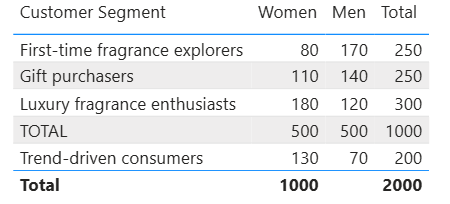
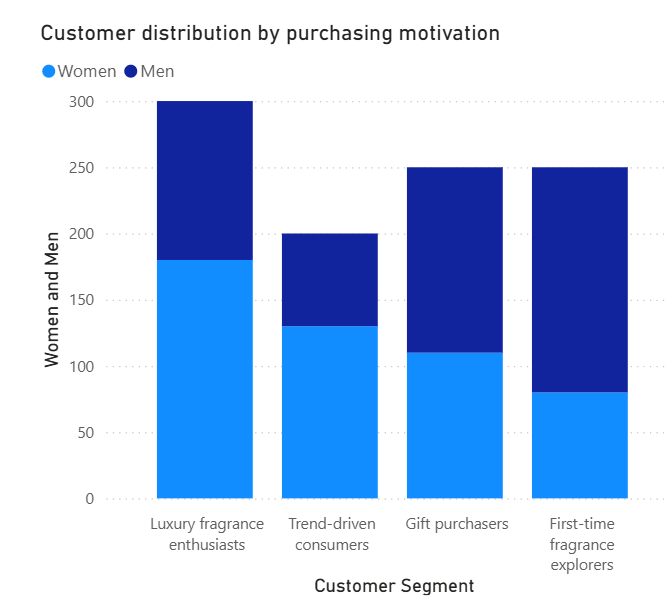
The sample indicates that luxury fragrance enthusiasts represent the largest category, accounting for 30% of consumers. Gift purchasers and first-time fragrance explorers each account for 25%, while trend-driven consumers represent 20%.
Although the overall sample contains equal numbers of women and men, the distribution differs across categories. Women represent 60% of luxury fragrance enthusiasts, while men represent 68% of first-time fragrance explorers. These differences suggest opportunities to examine purchasing motivations and campaign messaging, although they do not establish broader consumer preferences without additional representative data.
Projected promotional budget
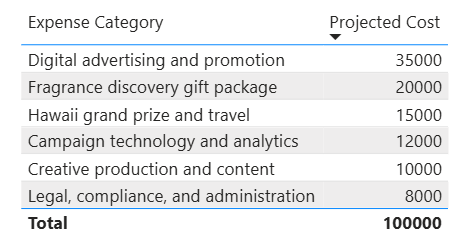
The campaign would require a hypothetical investment of $100,000. To evaluate whether this investment could generate a positive return, Interparfums would need to estimate incremental revenue and the contribution available after variable costs.
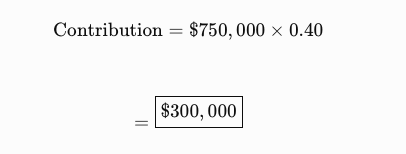
Assume the campaign reaches 200,000 consumers, produces 20,000 registrations, and generates 5,000 incremental purchases at an average transaction value of $150.
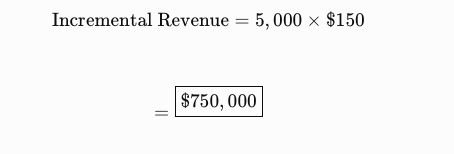
Assuming a hypothetical contribution margin of 40%:
The projected return on investment would be:
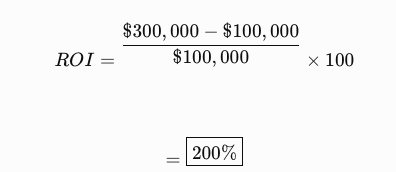

The projected 200% ROI suggests that the campaign could generate positive financial returns if its conversion and contribution assumptions are achieved. However, these estimates should not be interpreted as actual Interparfums results. The company’s annual reporting discusses promotional investments and business performance, reinforcing the importance of evaluating marketing expenditures in relation to measurable outcomes (Interparfums, Inc., 2026).
A key consideration is that gross revenue alone does not establish campaign profitability. Interparfums should measure incremental purchases relative to a comparable control group, monitor customer acquisition costs, and evaluate repeat purchasing behavior.
Business recommendation: Interparfums should use customer segmentation and financial modeling to identify high-performing promotional channels before expanding the campaign. Power BI dashboards could integrate participation data, conversion rates, promotional costs, and incremental contribution to provide leadership with a more comprehensive assessment of marketing effectiveness.
References
Interparfums, Inc. (2026). Annual report for the fiscal year ended December 31, 2025 (Form 10-K). U.S. Securities and Exchange Commission. https://www.sec.gov/Archives/edgar/data/822663/000175392626000464/ipar-20251231.htm
Montgomery, D. C., & Runger, G. C. (2018). Applied statistics and probability for engineers (7th ed.). Wiley.
National Institute of Standards and Technology. (2003). NIST/SEMATECH e-handbook of statistical methods.https://doi.org/10.18434/M32189
In-text citations: (Interparfums, Inc., 2026), (Montgomery & Runger, 2018), and (National Institute of Standards and Technology [NIST], 2003).


Leave a Reply