Financial Liquidity, Capital Investment, and Risk-Adjusted Cash Flow Forecasting
Business Context and Financial Performance
Cash flow management represents a critical executive responsibility for Interparfums, Inc. because international fragrance operations require consistent investments in inventory, brand development, marketing, supplier relationships, and distribution activities. The company’s financial stability depends on maintaining sufficient liquidity while allocating resources toward profitable growth opportunities.
According to Interparfums, Inc. (2026), consolidated net sales reached approximately $1.49 billion in 2025, compared with $1.45 billion in 2024 and $1.32 billion in 2023. The historical results demonstrate revenue growth, although sales growth alone does not establish sufficient cash availability for expansion.
The company’s financial statements provide the basis for evaluating profitability, working capital, financing requirements, and investment capacity.
Liquidity and Financial Statement Analysis
Interparfums’ financial position should be evaluated through the integration of income statements, balance sheets, and statements of cash flows.
The previous Interparfums financial dashboard identified a 2025 cash ratio of approximately 0.46 and return on equity of approximately 15.25%. These previously calculated dashboard measures should be reconciled with the underlying financial statement inputs before publication.
The cash ratio measures immediate liquidity:

A cash ratio below 1.0 indicates that cash and cash equivalents do not independently cover all current liabilities. However, this measure does not establish financial distress because receivables, inventory conversion, financing arrangements, and future operating cash flows also influence liquidity.
Cash Flow Forecasting and Capital Requirements
A rolling cash flow forecast can estimate future liquidity requirements and identify periods of increased financial exposure.
The following hypothetical model evaluates a four-quarter expansion scenario using projected operating cash movements and capital expenditures.
Illustrative Quarterly Cash Flow Forecast
USD millions; hypothetical planning assumptions
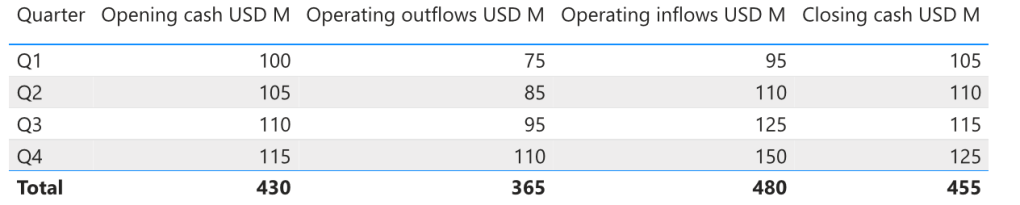
Note. Figures represent hypothetical expansion-related cash flow assumptions rather than Interparfums’ reported cash balances. Financing, dividends, taxes, and other cash movements are excluded.
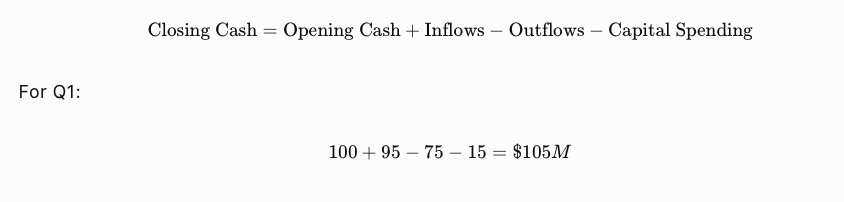
The projected closing cash balance is calculated as:
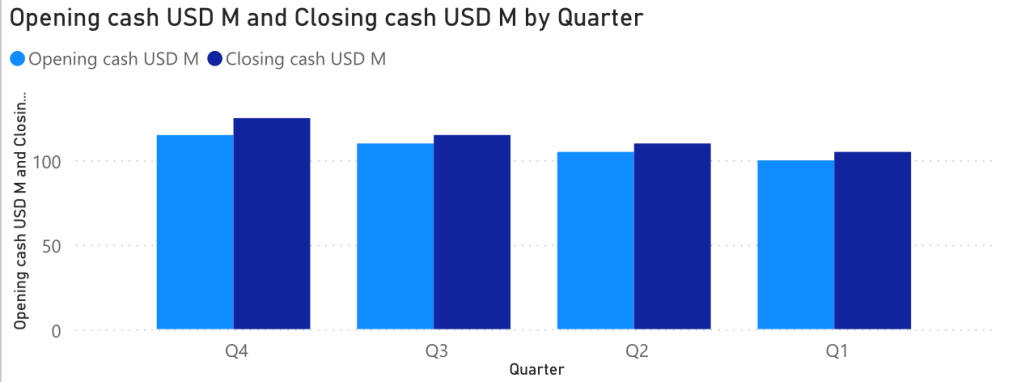
The scenario produces positive projected cash balances across all four quarters. Nevertheless, a favorable base-case projection does not eliminate the possibility of liquidity constraints under adverse conditions.
Financial Risk and Simulation Analysis
Monte Carlo simulation could evaluate financial exposure associated with fluctuations in consumer demand, inventory costs, foreign exchange rates, and capital expenditures.
A proposed simulation could generate 10,000 possible cash flow outcomes using probability distributions derived from historical financial and operating data. The resulting distribution would allow management to estimate the probability of falling below a predetermined minimum liquidity threshold.
Statistical inference could also support the development of cash flow prediction intervals, although the intervals would depend on model assumptions, sample quality, and the stability of historical relationships (Montgomery & Runger, 2018).
Financing and Capital Investment Decisions
Interparfums should evaluate internal cash generation, available borrowing arrangements, and strategic partnerships before obtaining external financing.
Capital projects should be assessed using Net Present Value (NPV), Internal Rate of Return (IRR), and payback analysis.
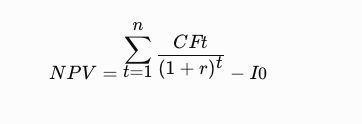
Where \(CF_t\) represents incremental cash flow, \(r\) represents the risk-adjusted discount rate, and \(I_0\) represents the initial investment.
Positive NPV indicates that projected discounted cash inflows exceed the initial investment under the selected assumptions. However, financing decisions must also account for debt servicing requirements, liquidity reserves, and uncertainty in future cash generation.
Executive Recommendation
Interparfums should implement a rolling 13-week cash flow forecast supported by quarterly capital planning and scenario analysis. Management should establish liquidity thresholds and evaluate proposed expansion projects using risk-adjusted NPV.
Capital expenditures should be authorized in phases, allowing leadership to reassess financial performance and market demand before committing additional resources.
References
Interparfums, Inc. (2026). Annual report for the fiscal year ended December 31, 2025 (Form 10-K). U.S. Securities and Exchange Commission. https://www.sec.gov/Archives/edgar/data/822663/000175392626000464/ipar-20251231.htm
Montgomery, D. C., & Runger, G. C. (2018). Applied statistics and probability for engineers (7th ed.). Wiley.


Leave a Reply