International Market Expansion Through Geographic Revenue Analysis and Predictive Decision Modeling
Business Context and Strategic Opportunity
International expansion presents an opportunity for Interparfums, Inc. to strengthen revenue diversification, improve market penetration, and capitalize on changing consumer demand for prestige fragrances.
The company’s geographic revenue disclosures provide a foundation for identifying regions with favorable historical performance.
According to Inter Parfums, Inc. (2026), Central and South America generated approximately $120.6 million in consolidated net sales during 2025, compared with $108.2 million in 2024 and $92.7 million in 2023. The region experienced approximately 11.5% revenue growth in 2025, outperforming consolidated company growth of approximately 2.5%.
These results suggest that Central and South America warrants further evaluation for potential market expansion.
Geographic Revenue Analysis
Table 4. Interparfums Historical Revenue by Geographic Region
USD millions; reported company data
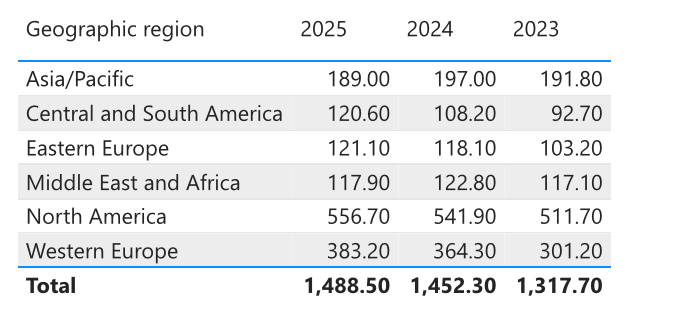
Source: Interparfums, Inc. (2026), Form 10-K, Notes to Consolidated Financial Statements, geographic net sales disclosure. Values rounded to one decimal place.
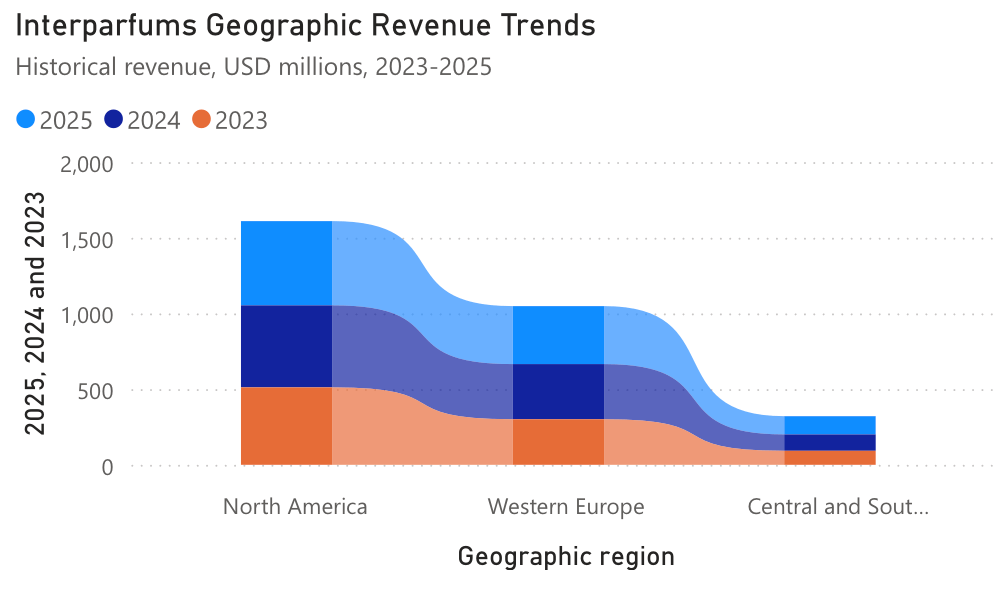
The data indicate sustained revenue growth in Central and South America during the three-year period. The regional growth rate suggests opportunities for additional distribution and brand development.
However, historical regional performance does not independently establish the attractiveness of individual countries. Country-level sales, competitive conditions, retailer concentration, consumer purchasing power, and regulatory requirements must be evaluated before capital allocation decisions.
Recommended Expansion Market: Brazil
Brazil represents a proposed priority market for a feasibility study and potential phased distribution expansion.
The recommendation reflects the historical performance of the broader Central and South American region and the opportunity to investigate additional prestige fragrance distribution. The recommendation does not assume that Interparfums lacks an existing Brazilian presence or that regional sales growth is attributable specifically to Brazil.
A phased strategy would initially emphasize distributor partnerships, selective retail placement, digital marketing, and demand validation rather than immediate construction of manufacturing facilities.
Strategic Decision Matrix
The following hypothetical evaluation compares three potential expansion strategies.
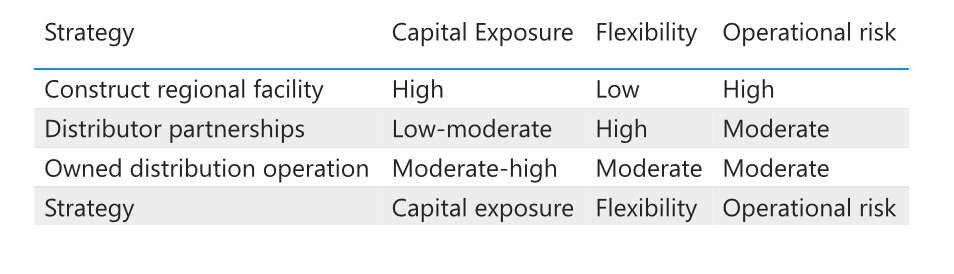
Note. The classifications are qualitative scenario assessments rather than verified project costs or measured risk scores.
A distributor-led approach could reduce initial fixed capital commitments while allowing management to evaluate market demand and retail performance.
Forecasting, Bayesian Analysis, and Risk Factors
Interparfums should evaluate market entry using historical sales, retailer demand, marketing effectiveness, economic conditions, and foreign exchange data.
Time-series forecasting could estimate revenue growth, while regression analysis could identify relationships between marketing investment, distribution coverage, and sales outcomes.
Bayesian inference could update the probability of meeting sales targets as new market information becomes available. Monte Carlo simulation could estimate the financial effects of changes in consumer demand, import expenses, currency exchange rates, and distribution margins (Montgomery & Runger, 2018).
Key risks include currency volatility, import duties, regulatory compliance, distributor concentration, competitive activity, and forecast uncertainty.
Forecast performance should be monitored through MAPE, RMSE, and prediction intervals. Management should also establish decision thresholds for market expansion, continuation, or withdrawal.
Executive Recommendation
Interparfums should prioritize a 12-month Brazil-focused market feasibility and distribution pilot, subject to country-specific validation.
The pilot should evaluate sales growth, gross margin, inventory turnover, marketing return on investment, and retailer performance. Expansion beyond the pilot should require evidence of sustainable demand, acceptable operational risk, and positive risk-adjusted financial returns.
The proposed approach provides a measurable growth strategy while limiting exposure to irreversible capital investments.
References
Interparfums, Inc. (2026). Annual report for the fiscal year ended December 31, 2025 (Form 10-K). U.S. Securities and Exchange Commission. https://www.sec.gov/Archives/edgar/data/822663/000175392626000464/ipar-20251231.htm
Montgomery, D. C., & Runger, G. C. (2018). Applied statistics and probability for engineers (7th ed.). Wiley.


Leave a Reply