Preventing the projected downside scenario requires coordinated financial, operational, and strategic risk management. Interparfums’ international operations create potential exposure to inventory accumulation, supplier delays, demand forecasting inaccuracies, and rising operating expenses. The company’s global business structure reinforces the importance of integrating operational and financial information into a consistent analytical environment (Interparfums, Inc., 2026).
Quantitative Risk Assessment
A proposed risk prioritization framework evaluates operational threats using five-point likelihood and impact scales. The combined score provides a structured method for identifying areas requiring management attention.

Table 2. Proposed Operational Risk Assessment
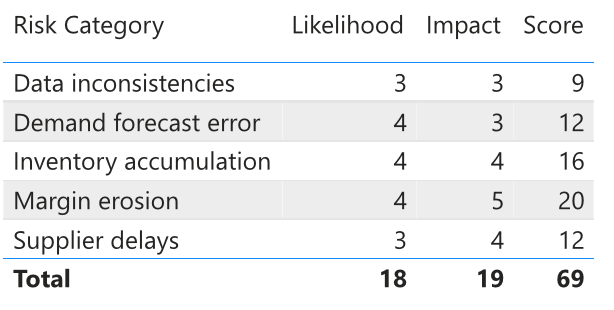
Risk scores are illustrative assessments, not empirically measured probabilities.
Risk Assessment Diagram
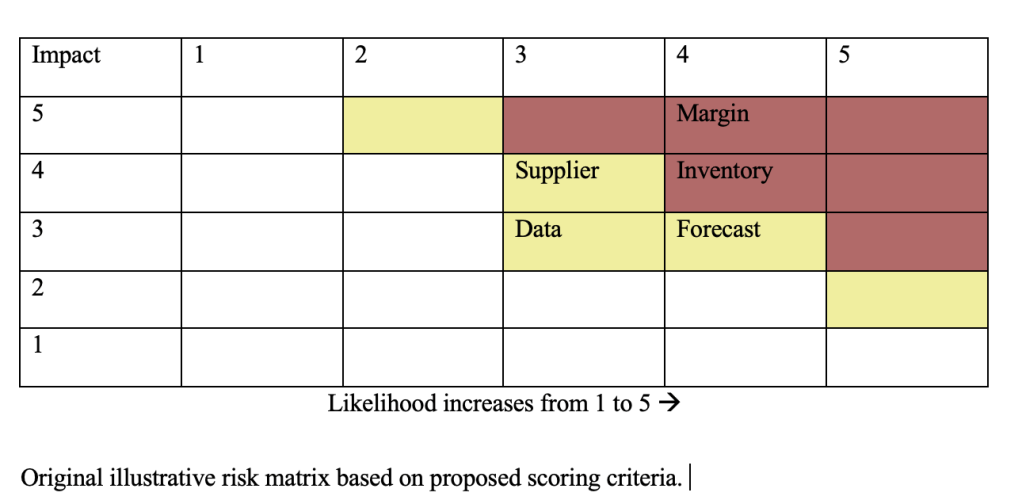
Note. Created by the author in Word.
Operating margin erosion and inventory accumulation represent the highest-priority risks within the proposed model. Management could mitigate these exposures through automated inventory monitoring, supplier performance scorecards, demand forecasting, and statistical process control. Risk scoring would support more consistent prioritization of corrective actions.
BIA Architecture and Project Implementation
A centralized BIA architecture would integrate enterprise resource planning (ERP), inventory management, supplier performance, sales transactions, and financial reporting systems. Extract, Transform, Load (ETL) processes would standardize records, validate data quality, and eliminate duplicate transactions before information enters a centralized data warehouse. Power BI could subsequently provide executive dashboards, predictive analytics, and automated exception reporting (Microsoft, n.d.).
Process Flow Diagram: Proposed BIA Architecture
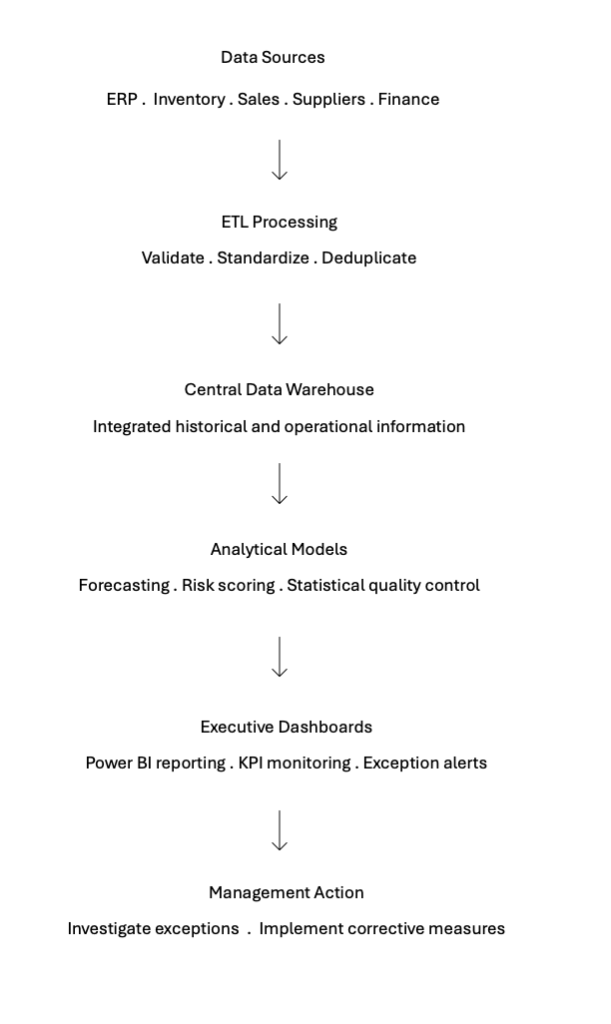
Note. Created by the author in PowerPoint.
The proposed implementation would follow a six-month schedule. Months 1–2 would focus on data assessment and governance, months 3–4 on architecture development and pilot testing, and months 5–6 on dashboard deployment, employee training, and performance evaluation.
Project management considerations would include cybersecurity, integration costs, technical staffing, data quality, stakeholder adoption, and executive sponsorship. Governance checkpoints would evaluate implementation progress and system reliability before expansion.
BIA Recommendation: Interparfums should establish a centralized risk dashboard featuring inventory turnover, forecast accuracy, supplier on-time delivery, defect rates, and net profit margins. Automated exception reporting would strengthen preventive decision-making and reduce reliance on retrospective financial analysis.
References
Interparfums, Inc. (2026). Annual report for the fiscal year ended December 31, 2025 (Form 10-K). U.S. Securities and Exchange Commission. https://www.sec.gov/Archives/edgar/data/822663/000175392626000464/ipar-20251231.htm
Microsoft. (n.d.). Power BI documentation. Microsoft Learn. https://learn.microsoft.com/en-us/power-bi/


Leave a Reply